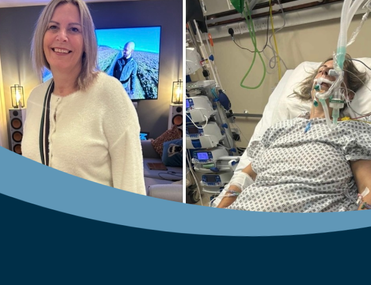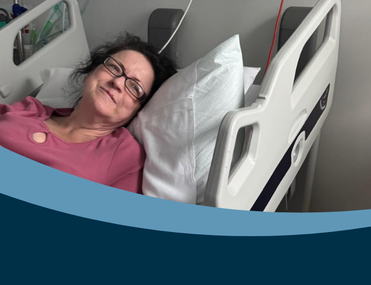
“Today, I often ask myself why I survived - I believe it’s because my story needs to be told so that the system changes."
The Sparkle in the Fluid: My battle with lymphocytic septic meningitis
Trigger warning - medical trauma
Rebecca Lewis, from Swansea, recounts her meningitis experience and explains why she believes she survived for a reason. And why she will spend the rest of her life using her voice to make sure others do too.
“In December 2016 I was 33-years-old, a single mum, working two jobs, and pushing myself to the limit. When the thunderclap headaches started—accompanied by a violent, terrifying 'whooshing' pain through the right side of my head—I tried to carry on.
“I didn't know that an invisible enemy was already eating away at my brain.
“On Friday 9 December, desperate to secure a permanent contract, I forced myself to attend my work Christmas party. The strobe lights and pounding music felt like physical blows. By the time I crawled into the hotel room I was sharing with a colleague, I was in absolute agony.
“When I woke up the next morning, the right side of my head was very swollen. My right eye was swollen completely shut.
Father Christmas first
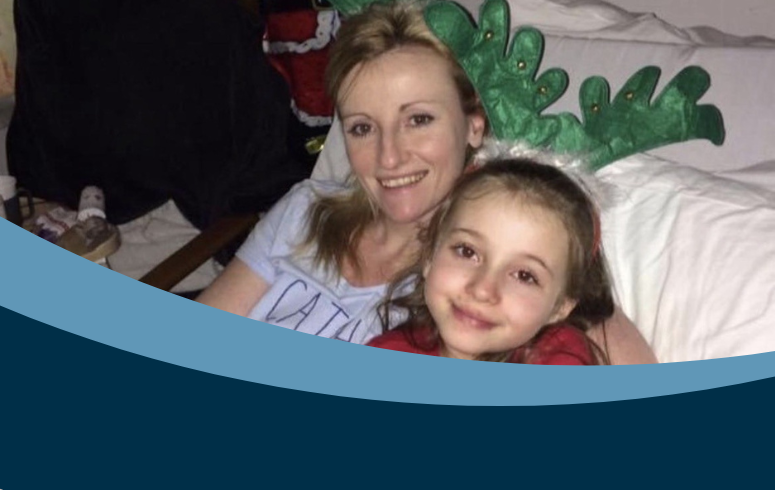
“I called my parents to ask them to fetch me. They arrived with the light of my life: my 7-year-old daughter, Sian. My parents wanted to rush me straight to the hospital, but a dark, instinctive dread had taken hold of me. I had a feeling I was gravely ill and I refused to let my last memory with my daughter be a hospital waiting room. Holding onto my fading balance and masking a blinding headache, I took Sian to see Father Christmas in the hotel first.
“The journey to Morriston Hospital in Swansea was a quiet torture. I wept softly into the passenger seat, stifling my sobs so Sian wouldn’t see how much pain I was in.
“At A&E, the receptionist told my mother there would be a six-hour wait. Knowing instinctively that I didn't have six hours, my mother became my fierce protector. She forced the staff to look at me, to really look at me. Minutes later, I was rushed straight into the red resuscitation zone. By now, the photophobia had set in. The ambient hospital light felt like a drill boring directly into my skull.
Lost in the system
“Despite the urgency of my admission, I was moved to an elderly care ward. My symptoms spiralled out of control: my temperature soared, vomiting was constant, and the pressure in my head was so severe it felt as though my brain was physically falling out of my skull.
“On Wednesday 14 December, a consultant abruptly stopped my morphine, claiming the medication was causing my headaches. That night was a descent into hell. I screamed in agony for hours until a nurse, broken-hearted by my distress, defied orders and gave me pain relief. Still, no official diagnosis came, despite my family and friends repeatedly begging the doctors to check for meningitis.
“When they finally decided to perform a lumbar puncture on Friday the procedure became a horror story. I was taken to an X-ray theatre. As I lay on my left side, I noticed the consultant’s voice sounded muffled, like my right ear was blocked. I didn’t know it yet, but the meningitis was actively destroying the auditory nerves on the right side of my face. At the same time, I was losing my sight in my right eye – I am now permanently deaf and blind on the right side.
Sudden, pitch-black blindness
“During the procedure, the needle struck the wrong nerve. Sudden, pitch-black blindness struck me. I panicked, terrified that I was permanently blind. The consultant withdrew, repositioned, and finally tapped the spinal column.
“As the cerebrospinal fluid began to pour out of my back, the team realised they didn't have a sterile bottle to catch it in. I lay there, fluid draining, while someone was dispatched to the second floor to find a container. When the consultant finally held up the vial, the fluid inside was shimmering. It looked like it was genuinely sparkling. I knew, with sinking certainty, that spinal fluid shouldn't sparkle.
“The errors, however, only intensified. Just after that agonising lumbar puncture, while I was still profoundly weak and disoriented, I was taken to a CT scanner. As I was moved into the machine, my arm—along with the cannula inserted into it—got severely jammed inside the mechanism.
"Terrified, trapped, and in excruciating pain, I was crying and pleading for help, but nobody came. As a direct result of being left stuck in the machine, I developed an extravasation or infiltration injury. The fluids leaked into the surrounding tissue, causing my arm to balloon with severe swelling and turn a horrific purple colour. I had to endure having my arm elevated for three days before the swelling finally began to subside.
The fight for survival
“The next day, a doctor walked in and casually suggested I could go home. I was incredulous. I was in agony, my eye was sealed shut, and I was deteriorating by the second. Hours later, the fog cleared when a brilliant neurologist, Professor Sawney, spoke to my brother.
“The sparkle in the fluid wasn't a good sign. My lymphocyte count was over 300; it was supposed to be below 10. The diagnosis was definitive: Lymphocytic Septic Meningitis.
“I was whisked to a neurology ward, isolated in a dark room, and fitted with a PICC line directly into my artery to blast my body with urgent antibiotics.
“I spent six weeks in that hospital, missing Christmas with my little girl. Breaking that news to Sian broke my heart. When she came to visit me on Christmas Day, I had withered away to skin and bones. She was incredibly brave, but seeing her mother like that must have been traumatic and still haunts her to this day. I truly believe I survived those weeks purely because I refused to leave her without a mother. I was living for her.
“The mistakes didn't stop with my diagnosis. While still gravely ill, I was loaded onto a multi-stop patient transport ambulance for an eye test at a different hospital. For an hour and a half, the ambulance meandered through the region dropping other patients off. With no balance, I kept collapsing sideways, vomiting every ten minutes into a cardboard bowl. By the time I returned via blue lights, my panicked parents and friends had arrived at my empty hospital room. No one knew where I was. They thought I had died.
The scars that remain
“I was eventually discharged, but the delay in my diagnosis had already taken its toll: I was permanently blind and completely deaf on the right side of my face.
“The nightmare wasn't over. A few days after arriving home, while alone with Sian, a wave of illness overcame me. I blacked out, fainting backward straight into a bookshelf. My poor daughter was traumatised all over again as she ran to get my parents. I was rushed back to the hospital, where it was discovered I had been discharged with active sepsis.
“Remarkably, it was only after I finally came home from the hospital that the textbook all-over meningitis rash appeared across my body. It serves as a stark, terrifying proof that the classic rash doesn't always show up at the very beginning of the illness—sometimes it manifests much, much later, challenging everything the public is taught to look out for.
“There was no NHS aftercare at home. The physical and psychological toll of losing my sight and hearing overnight, coupled with the trauma of nearly dying, left deep scars on me, my daughter, my entire family and friends.
So much needs to change
“Today, I often ask myself why I survived when this devastating illness claims the lives of so many vibrant young people. I believe it’s because my story needs to be told so that the system changes. So much needs to change with how meningitis is handled and treated.
“Diagnosis needs to be swifter. A simple brain inflammation test and an immediate lumbar puncture should be mandatory the moment meningitis is even suspected. Furthermore, our government must protect young people by ensuring the Meningitis B vaccine is readily accessible to ALL those who need it so that our youth stop needlessly dying.
"Meningitis is a medical emergency; it must be treated with the gravity it deserves. My form of meningitis is recurrent and can come back at any time; it came back in June 2018 and could return at any point.
“I am eternally grateful to the individuals within the NHS who kept me alive, and to my incredible daughter, family, and friends who held my hand through the darkness.
“Today, I am proud to stand as an active volunteer for Meningitis Now. The work they do to support survivors and raise awareness is lifesaving. My dedication to the cause has taken me all the way to Parliament with the charity, where I have spoken directly with lawmakers about the critical need for better, more compassionate, detailed aftercare at home following a meningitis diagnosis.
“Closer to home, I have also had the honour of hosting two Swansea Half Marathons alongside them to champion their vital work. I survived for a reason—and I will spend the rest of my life using my voice to make sure others do, too.
“Life today is brighter than I ever could have imagined back in that dark hospital room. I share my life with an amazing partner, Emma, my wonderful daughter, Sian, my stepson Isaac, as well as my lush family and friends – while successfully running my own business.”