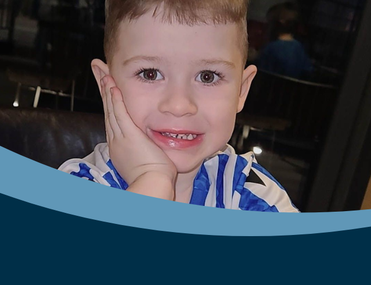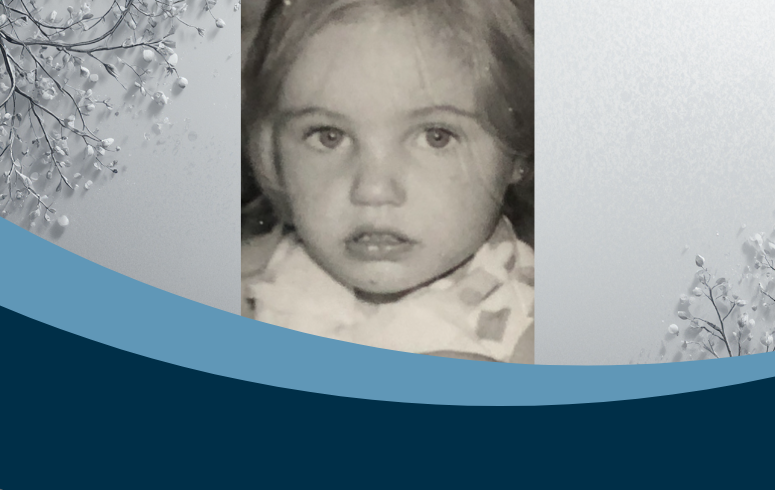
“I’ve learned to live with the grief, but it always stays with you. Julie was such a lovely, outgoing child, loved by all.”
Julie’s death came as a profound shock to Janet and her husband Brian. The couple had never heard of meningitis.
Their grief continues to this day but following the progress of vaccinations and research has given them hope that families like theirs won’t experience what they had to go through. Janet says:
“Reading the stories on the Meningitis Now website and reflecting on the progress that has been made in the fifty-one years since the death of my daughter, Julie, I felt moved to share my own experience.
“Brian and I were married in 1967 and in 1975 we were living in the Brixton area with our son Darren, aged 7, and our daughter Julie, aged four and a half. On Friday 6th June Julie spent the morning at her nursery school and was picked up by a friend, as usual, where she stayed until Brian collected her and Darren at 4pm and took them to Clapham Common.
Lack of energy
“Julie began to play but seemed listless and soon laid down on the grass. On reaching home she laid on the couch and was still there when I returned from work. The lack of energy in a child so normally active was alarming and we made the decision to take her immediately to our doctor in Stockwell.
“Brian carried her there and I cradled her on my lap as the doctor took her temperature. She was no longer able to stand up. Without further examination he sent us home with medication to bring her temperature down.
“Later that evening Julie started having convulsions. I immediately phoned the doctor and got through to his mother. It was now outside surgery hours and she informed me that he was out and that she would ask him to ring me when he returned. In the event she phoned back herself and relayed the message that we were to continue with the medication.
Softly moaning
“Julie continued to be listless and showing little response. When I heard her softly moaning, I again phoned the doctor but the response, again communicated through his mother, was to continue what we were doing.
“I nursed Julie throughout the night. When I attempted to help her drink some water she was unable to raise her head without help and moaned again as I tried to assist. At 6am I noticed two black bruises in the kidney area - which I now recognise are symptomatic of kidney failure as the body attempted to cope with the toxins in her body.
“Again I phoned our doctor and was told to bring Julie to the surgery when it opened. This time I was seen by a locum as the doctor who had previously seen Julie was not available that morning.
“He asked us some questions and, focussing on the fact that we had returned three days previously from a holiday in Spain - told us to go home and that he would arrange for an ambulance to take Julie to the Hither Green Hospital for Infectious Diseases.
No sense of urgency
“The ambulance duly arrived and transported us to Hither Green with no sense of urgency and no blue lights. The hospital itself had no accident and emergency department and no intensive care facilities.
“A series of questions were asked, including details of what Julie had eaten, before a decision was taken to put her on the ward. Brian and I were increasingly desperate for some action to be taken but no doctor was called. A nurse just gave us a jug of water and glass. I sat with Julie and it was not until I noticed her body turning black that the nurse called for a doctor to be brought from outside the hospital.
“Septicaemia was diagnosed around noon and Julie was put on a drip but still no medication was given. At 2pm she died. Her little body was black all over. The hospital staff took us into a private room for a while and gave me some Valium before we were left to make our way home.
Numb with shock
“In retrospect I realised that I was numb with shock and grief. In the immediate aftermath I coped by comforting others and repeating my story over and over again. I blamed myself for not going straight to King’s College Hospital and following my instincts instead of trusting my doctor.
“Every death brings guilt but the death of a child inevitably brings so much self-recrimination as Brian and I went over and over the events leading up to Julie’s death, examining what we could have done differently and the actions that we might have taken.
“The following day I saw Julie’s body. The black discolouration had gone and I could see the transfers that she had placed on her body while we were on holiday. She was laid among candles and covered in a beautiful robe.
“It was not until the post-mortem that meningococcal meningitis was diagnosed. Until that point I had never heard of the disease and, at the age of 25, I had never even contemplated dealing with the death of a child.
“In the months that followed I became ill, unable to focus and not wanting to live. No bereavement counselling was suggested but I was referred to a psychiatrist and then a psychotherapist which was available free on the NHS for 6 months and with whom I continued privately for a further 5 years.
Grief was always present
“During this time I learnt to live with the fact of Julie’s death although the grief was always present. Some 20 years after the death of Julie I became a Christian and I now find comfort in the knowledge that I will hold her in my arms again.
“As Brian and struggled to come to terms with the death of Julie, Darren also grieved at the loss of his little sister and was referred to a child psychologist. Even Faye, born seven years after the death of Julie, is affected by the death of a sister she never knew and the anxiety that surrounds the health of each child within the family.
“In the years since Julie's death, I have followed closely the advances in diagnosis and treatment for meningitis. A major milestone was establishing the Meningitis Trust (now Meningitis Now) which has been so instrumental in raising awareness among laymen and professionals.
“Publicity campaigns on recognising the symptoms have saved many lives through early diagnosis and the support groups and counselling for those who have suffered the loss of a loved one or the life changing effects of the disease.
Brought such hope
“The research that Meningitis Now funds and supports is so important and has brought such hope. The news of a vaccine for meningococcal meningitis was such a major breakthrough and I find it so frustrating that the government does not recognise the need to extend immunisation to all.
“The positive I take from this is the enormous changes in the understanding and support around meningitis in the last fifty years. It gives me hope that future generations will be saved from this awful disease.”
“The passing of Julie in such a short space of time shows that treatment must be given immediately. 50 years on, I still ask myself if it really happened. I’ve learned to live with the grief, but it always stays with you. Julie was such a lovely, outgoing child, loved by all.”